 200 E. 30th Street, Kansas City, MO 64108, USA.
 +1 (816) 7723095

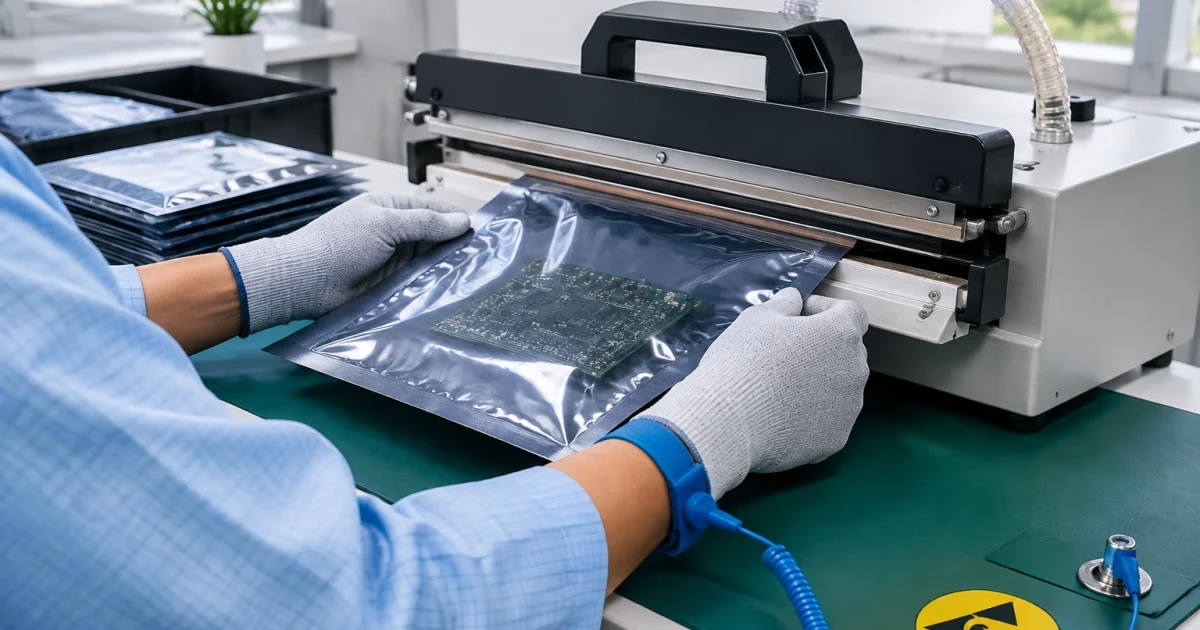
Electronics manufacturers have always managed two packaging risks: electrostatic discharge (ESD) and moisture. What’s changed is the packaging itself. Many films now combine ESD control, moisture barrier performance, puncture resistance, and sealability in a single laminated structure. That helps protect sensitive devices, but it also makes the sealing step more process-sensitive.
If you’re evaluating an esd vacuum sealer for production packaging, you may be dealing with more film variations, tighter internal specs, and stronger expectations from quality teams for consistent settings and repeatable results. Below is what’s changed in materials and what that means for equipment selection, setup, and daily operation when sealing anti-static, shielding, and moisture barrier bags (including cleanroom-adjacent workflows).
Electronics packaging films used to be easier to sort into categories: anti-static bags, shielding bags, and separate moisture-control steps for MSL devices. Today, multi-layer laminations are common and are designed to deliver multiple properties at once—often without adding much thickness. That’s good for protection, but it can narrow the sealing process window.
When the inner sealant layer changes (or when a supplier adjusts a structure without changing the part number), yesterday’s settings may produce different seal quality. For ESD- and moisture-sensitive electronics, that variability is a real packaging risk.
Many modern films combine sealants with barrier layers (metallized or foil-like) and ESD-control layers. Each responds differently to heat, dwell time, pressure, and cooling. A seal can look fine yet still have weak bonds, wrinkles, or small channels that later become leak paths after handling.
This is why electronics lines often need tighter control over sealing parameters and consistent heat distribution—especially on wider bags for boards, trays, or multiple reels.
“Anti-static” can mean dissipative bags, shielding bags, moisture barrier bags with anti-static layers, or hybrids. Different constructions can prefer different sealing approaches. Some seal well with impulse methods; others require constant heat or more deliberate cooling to avoid warping, delamination, or surface marking.
So when a team looks for an anti static bag vacuum sealer, the real need is usually a machine that can be tuned to their specific bag structure—not a generic sealer with a single “good enough” setting.
As films become more complex, the sealer must be more controllable and repeatable. For electronics packaging, the right machine consistently reaches the required vacuum level (and optional gas purge), produces a robust seal, and supports ESD-aware handling in the packaging cell.
For moisture barrier packaging and sensitive assemblies, focus on:
When you run multiple bag types, recipe storage (settings by bag/SKU family) reduces operator guesswork and strengthens repeatability for quality.
Packaging failures often appear later: a corner opens in handling, a tiny channel leak shows up in storage, or a marginal seal fails in distribution. Helpful equipment capabilities include:
Electronics packaging increasingly adopts a validation mindset: control key variables, document settings, and reduce operator-dependent outcomes.
Both snorkel/nozzle systems and chamber machines can work for electronics. The best choice depends on bag size range, throughput, cleanliness requirements, and how delicate the product is during evacuation and sealing.
A snorkel vacuum sealer (nozzle/external) evacuates air through a nozzle inserted into the bag opening, then seals. For electronics, it’s often selected when:
Because the product stays outside a chamber, operators can support awkward loads and reduce crush risk. The key question is whether the machine can consistently pull the required vacuum and seal anti-static moisture barrier structures without scorching, wrinkling, or channeling.
Chamber machines evacuate the entire chamber volume, which can deliver highly repeatable conditions. They’re often chosen when:
If your operation spans multiple packaging types, it can be useful to evaluate a range of Chamber Type Vacuum Sealers for products that fit chamber packaging, while using nozzle systems for oversized or variable loads.
“ESD-safe vacuum sealing” depends on the full packaging cell, not just the sealer. A capable machine can’t compensate for poor grounding, charge-generating handling, or film scuffing that builds triboelectric charge.
For electronics lines—especially near cleanrooms or controlled areas—buyers often need stainless or smooth, cleanable surfaces and designs that reduce particle traps. This is why interest in a cleanroom vacuum sealer and cleanroom vacuum heat sealers continues to grow: packaging is part of contamination control.
If you operate in or near a controlled environment, consider whether Cleanroom Type Vacuum Sealers align with your cleaning protocols, maintenance access needs, and surface requirements.
ESD-safe outcomes usually come from integrating equipment with the workstation and operator steps:
When evaluating an electronics components vacuum sealer, include real operator motion in trials. Many “machine problems” are actually staging or handling problems that show up as wrinkles, channels, or inconsistent seals.
Because requirements vary by material, a structured evaluation helps you avoid buying a system that demos well but struggles on your line. Insist on trials using your actual bags and typical loads.
Document bag constructions (anti-static, shielding, moisture barrier, laminated structures), thickness ranges, and your smallest/largest sizes. Include whether you seal single items, kits, or multiple items, and whether rigid carriers (trays, reels) are common. This quickly narrows whether a nozzle system or a chamber approach fits—and what seal bar length you need.
Define the performance target your packaging spec emphasizes:
Even without 100% leak testing, clear criteria makes it easier to choose equipment that meets the spec without constant adjustment.
More heat isn’t better if it damages the film. Prioritize stable control of time, temperature, and pressure, plus consistent vacuum performance. For high-mix operations, PLC/HMI controls and recipe management can reduce training time and improve changeover consistency.
Some components and specialty materials benefit from nitrogen or inert gas purge to reduce oxygen or control the pack atmosphere. If it’s part of your strategy, evaluate gas purge capability alongside vacuum performance. In some cases, vacuum + gas purge can also reduce stress compared with aggressive evacuation alone.
Cleanroom-adjacent packaging and high-mix electronics lines often require easy cleaning, reliable uptime, and predictable maintenance. Confirm access to wear parts, sealing element serviceability, and how quickly operators can return to approved settings after service.
If you’re still deciding which architecture fits best, Comparing Nozzle Vs Chamber Vacuum Sealers For Cleanroom Use can help you map machine type to bag size, cleanliness needs, and throughput goals.
ESD and moisture-protection films have improved, but they’re often more sensitive to sealing variability. For electronics packaging teams, that makes vacuum sealing a process-control decision: can you reliably hit vacuum targets, produce robust seals on today’s laminated anti-static and moisture barrier bags, and do it in an ESD-aware workstation that supports quality requirements?
The most reliable approach is to test machines with your real materials, define pass/fail criteria for seal integrity, and prioritize controllable, repeatable settings. Whether you choose a flexible snorkel/nozzle system or a chamber machine for cycle consistency, aligning material structure, sealing technology, and ESD workflow is what protects the components you ship.
Yes—if the sealing method and settings match the bag’s sealant layer and laminate structure. Most issues come from excessive heat, uneven pressure, or insufficient cooling, which can wrinkle the seal area or create channels. Test with your exact bag construction and confirm both seal integrity and handling durability.
The machine may look similar, but the requirements are different: electronics packaging needs repeatable control of vacuum and seal parameters, compatibility with anti-static/moisture barrier laminations, and a workstation setup that supports grounding and low-charge handling. Cleanability and low-particle considerations can also matter for cleanroom-adjacent packaging.
Choose a snorkel/nozzle style when you seal large or variable-size bags, awkward loads, or product that’s easier to support outside a chamber. Choose a chamber machine when you want highly repeatable cycles for consistent pack sizes or standardized kits, and when chamber dimensions comfortably fit your largest bags.
Sometimes. If oxidation control or a specific pack atmosphere is important, nitrogen or inert gas purge can be integrated with vacuum sealing. The decision depends on your product sensitivity and packaging specification; it’s typically evaluated alongside moisture control practices such as barrier materials and desiccant use.
Bring your real bags and typical loads (reels, trays, boards) and test multiple cycles for consistency. Check seal appearance, seal strength, and whether corners or edges show channel leaks. Also evaluate operator workflow—how the bag mouth is presented, how product is supported during evacuation, and how repeatably different operators can achieve the same result.
If you’re updating electronics packaging materials or tightening seal requirements, Nasavac can help you match the right sealing approach to your bags, loads, and environment—whether that’s a flexible nozzle (snorkel) system, a chamber machine, or a gas purge configuration. Share your bag construction, sizes, and throughput goals, and we’ll help you narrow down a solution with the control and repeatability your ESD program expects.
We hope you find this article helpful. The content provided is for general information purposes only. Readers are encouraged to verify product specifications, compliance requirements, and suitability for their specific applications with the relevant manufacturers or certified professionals. While we strive for accuracy, we cannot guarantee that all information is error-free. NASAVAC assumes no responsibility for any errors or omissions.
